|
Ancient reptiles of the deep, sea turtles
have long been surrounded by mystery and ignorance. Now
as a result of much research by dedicated scientists and
conservationists, our knowledge of these puzzling wild creatures
is expanding. Experts believe that obtaining a complete
picture of a turtle’s life cycle may be the key to
saving them from extinction.

Green turtles were heavily exploited
in the 1920’s for turtle soup by canneries on Heron
and North-West Islands off central Queensland. Around a
thousand nesting female turtles were harvested each year
from North-West alone, almost resulting in the total decimation
of that island’s breeding population. In other parts
of the world such as the Cayman Islands, Bermuda and the
Dry Tortugas, entire populations have become extinct through
commercial exploitation by man.
Of the seven existing species of sea
turtle, six are today listed as threatened or endangered.
In 1950, Green turtles became protected in Queensland and
in 1968 this legislation extended to include all turtle
species. Despite this, most of the remaining populations
are still in danger of disappearing.

Will Sea Turtles still be here for our  children
and grandchildren to enjoy? Research is necessary
to determine the migratory habits of the sea
turtle.
|
|
QUEENSLAND SEA TURTLE PROJECT:
Colin Limpus, zoologist in charge of the Queensland Sea
turtle project, has been studying turtles for twenty years,
but having grown up near a turtle rookery his involvement
with them goes back even further. “We still don’t
know how to manage a sea-turtle population to ensure that
they will survive,” he says. “We don’t
know if what we are doing now will guarantee that there
will be turtles still here for our children and our grandchildren.”
Limpus is assisted in his research
by Emma Gyuris, a microbiologist and zoologist who has been
working with turtles for six years. “I first became
interested in 1980, when I went to Heron Island for a holiday
and saw Colin Unloading turtles from a boat. I hung around
and made a nuisance of myself for the rest of my stay. I
wanted to get more involved in turtle work and found that
I could do so through an education program Colin had going
at Mon Repos Beach near Bundaberg. It was like a childhood
dream materializing in front of me. I am now working toward
a PhD on turtles.”
The problems involved with conserving
turtles are numerous and perhaps one of the greatest difficulties
lies in determining the size and structure of the populations
we are trying to preserve. Much of the work being done by
Colin Limpus and Emma Gyuris concentrates on piecing together
this complex jigsaw puzzle.
Every day during the summer they can
be seen perusing Heron Reef in their aluminium boat, searching
for Green, Loggerhead and Hawksbill turtles. Because of
the skill and speed involved in capturing these strong and
agile animals, this catching has come to be called “turtle
rodeo” and indeed as Gyuris dives from the speeding
boat onto a turtles’ back and swims it to the surface,
one can see why. Once aboard, the turtles are tagged by
their front flippers with numbered titanium labels and some
are taken back to shore for laparoscopic examination, by
which their sex and maturity level are ascertained.

Loggerhead sea turtles Caretta caretta swimming
freely in the waters of the Great Barrier Reef
|
|
“We are still looking at turtles
that were born before we were,” says Limpus. “We’ve
got to, as fast as we can, learn the basic parameters of
a turtles life cycle so that we can see just where the weak
points are in that life cycle and start addressing them.”
Turtles spend almost all of their lives
at sea migrating thousands of miles across international
boundaries, making them extremely difficult to track and
more importantly to protect. "The problem is that even
if we do achieve total protection of turtles within the
Barrier Reef, many of the turtles that nest here migrate
through developing countries such as Indonesia, the Philippines,
New Caledonia and Papua New Guinea," says Gyuris. "In
these countries protection laws may be inefficiently enforced
or there simply may be no laws to enforce."
TURTLE EXPLOITATION versus
SURVIVAL:
The people of these countries are under great economic pressure
and turtles can bring in a great deal of money. Unfortunately,
there is a high world demand for turtles and turtle products
and it is these developing countries which supply the ever-expanding
market.
Almost every part of a sea-turtle can be used for commercial
purposes: The carapace or shell is much sought after for
jewellery and ornaments; the skin of the neck and flippers
is used for leather; the meat and eggs can be eaten; the
calipash and calipp (flesh of the breast and flippers) along
with the neck and tail bones are used in making turtle soup;
the offal is manufactured into fertilizer; and the oil is
used as a base for beauty creams. Some unlucky specimens
are stuffed or freeze-dried and sold as souvenirs to tourists
in countries like Indonesia and Thailand.
The three species mainly being exploited today are the Hawksbill,
Olive Ridley and Green turtles. Unlike other varieties the
Hawksbill does not regularly shed its scales, making its
carapace the thickest and most beautifully patterned of
turtle shells. From the Hawksbill comes "tortoiseshell"
and international trade in this product is alarmingly extensive.
"In 1978 world raw tortoiseshell imports totalled 319,290
kg." (Mack, Duplaix and Wells, 1981.) Indonesia appears
to be the chief exporter and Japan, Taiwan and Hong Kong
the main importers. It is believed that at least 111,000
Hawksbills must have been slaughtered that year for their
pretty shells. As statistics point to an increasing volume
of tortoiseshell on the world market, scientists report
ever declining Hawksbill numbers. It seems that Hawksbill
turtles have never been very numerous and if the tortoiseshell
trade continues as it is, the species will certainly be
unable to survive.

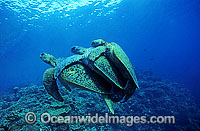
Green sea turtles Chelonis mydas
are feeding on jellyfish in these photos.
It is easy to see why many turtles die every
year while 
choking on plastic bags. Sea turtles easily
mistake plastic bags floating in the water as
jellyfish and feed on these with fatal consequences. |
|
A MILLION TURTLES TAKEN:
Another species giving considerable cause for concern is
the Olive Ridley turtle, which nests in large numbers on
the Pacific coast of Central America. Because the gravid
females concentrate their nesting activity to only a few
major rookeries, they are extremely vulnerable and are heavily
harvested in Ecuador and Mexico. Reptile skins - tanned
and fashioned into shoes, bags and belts have always been
like furs, expensive luxury items for conceited display.
They traditionally came from crocodiles, caymans and snakes,
but now those sources have been severely exhausted and the
market has turned around and begun using turtles for leather.
The unfortunate Olive Ridley turtle has been the main species
to come under this latest assault. "From 1970 to 1977,
an estimated one million Olive Ridleys were taken on the
Eastern Pacific coast by Mexico and Ecuador to supply the
skin and leather trade. Skins from an estimated 85,000 Ridleys
were exported in 1978 to Ecuador and during the same year,
Mexico captured 50,000 Ridley turtles (mainly gravid females)
in the state of Oaxaca alone." (Mack, Duplaix and Wells,
1981) Olive Ridleys continue to be killed at this rate,
the Central American rookeries will cease to exist within
the next few years.
The vegetarian Green turtle is thus named because of its
green body fat and is known for its tasty flesh. Consequently
the threat to this species arises from local consumption
and trade in canned turtle steaks and soup. The main importers
of turtle meat are West Germany and the United Kingdom,
although most of this comes from the Cayman Turtle Farm
on Grand Cayman Island where Green turtles are raised and
farmed commercially. Although turtle farming would seem
to many people an ideal solution to the problem of wild
turtle harvesting, there is much criticism that it in fact
perpetuates and encourages a market for turtle commodities.
Apart from all that, turtle farming is a very expensive
enterprise and one it seems, that has proven to be economically
impractical. When the Australian Government sponsored several
experimental farms on the Torres Strait Islands back in
the 1970s, they were found to be hopelessly uneconomical
and were closed.
Under Australian law, indigenous peoples North of Cooktown
are permitted to catch turtles for their own use as their
ancestors have done for thousands of years. However their
ancestors did not have speed boats, nor were the numbers
of turtles so severely depleted in those days.
"Surveys indicate that an annual harvest rate of the
order of 10,000 Green turtles occurs in the Torres Strait
area." (Limpus, 1981.) Is this more than the population
can replace? We don't know.
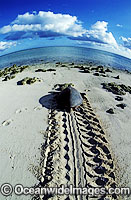
Loggerhead sea turtle Caretta caretta
nesting on her natal beach (top left). Green sea
turtle Chelonis mydas depositing ping
pong sized eggs in a specially dug sand chamber.
She
then covers the eggs which are incubated in the
sand, and then makes her way (top right) back
to the ocean. An unusually large aggregation of
Green sea turtles Chelonia mydas on the
edge of Raine Isand reef. At nightfall emerge
on Raine Island, Great
Barrier Reef, in their thousands to lay eggs (bottom
left). Each female laying up to three times in
one season. |
|
LIFE CYCLE:
One aspect of sea turtles which makes them such fascinating
animals is their obscure and perplexing life cycle. For
instance, when a newly hatched turtle leaves its natal beach
it is unlikely to be seen again until it reaches around
30 centimetres in length and an estimated age of ten to
fifteen years. Where these young turtles spend the early
part of their lives is a complete mystery, though it is
speculated that they drift with ocean currents for great
distances and remain in the open ocean until they reach
a certain level of maturity. Says Limpus: "it used
to be thought that turtle hatchlings were lost at sea for
a year. Since 1979 we have thought that they are lost for
at least a decade. Some people still don't believe us. Between
1973 and 1982 we tagged about a quarter of a million hatchlings.
None of them have returned yet." It is believed that
turtles return to where they were born many years later
to nest. Says Limpus: "Since in the South Pacific,
Loggerhead turtles nest only in the Capricorn - Bunker group
of islands, the assumption is that they must have been born
there." He adds ironically: "We have only got
to wait another forty years to find out whether it's true."
Turtles take many years to grow to maturity. It is thought
that a female turtle is around fifty years old when she
begins to mate and breed. When her first breeding season
finally comes around, she drags herself up onto the beach,
digs first a body pit and then an egg chamber of around
50 cm. depth and lays an average of 50 to 130 ping-pong
ball sized eggs depending on the species. Over the course
of that one season she may repeat the procedure up to eight
times, laying a total of 500 to 1000 eggs. Of these maybe
one or two will reach adulthood. Her nesting season complete,
the female will probably not mate again for another three
to six years.
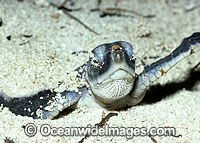
| Green
sea turtle Chelonia mydas in the afternoon
light (top left).
.
Hawksbill sea turtle Eretmochelys imbricata
close-up of head (bottom left). |
|
TEMPERATURE DETERMINES SEX:
The turtle eggs incubate in the sand for around seven weeks
during which time the embryos develop into miniature turtles
of 4 to 6 cm. in length. Recent studies have uncovered some
astonishing facts about embryonic turtles. The nest is in
fact a complete micro-environment where factors such as
temperature, sand type, moisture and position on the beach
will affect the outcome of the eggs. The sex of a turtle
embryo is not genetically determined at conception. When
the eggs are laid the embryos within are sexless and whether
they turn out to be male or female depends entirely upon
the temperature of the sand around the nest. If the sand
is 27 degrees Celcius or cooler there will be more males
and if it is over 30 degrees, females will predominate.
Thus, some beaches produce greater numbers of one sex than
others. Though most of the eggs will develop into healthy
baby turtles, some will fall victim to crabs and infestation
by fungus.
When the baby turtles hatch they spend
a few days in the sand, gradually making their way to the
surface and when the time is right (usually at night) they
emerge together and make an energetic dash down to the water.
It is by some innate sense that these tiny creatures, which
look something like wind-up bath toys, know exactly in which
direction the sea lies, even when it is obscured by ridges
or walls. They instinctively more toward the brightest light
source which is normally the light area on the horizon.
They can be disorientated by artificial light, however,
so every effort is made at rookeries to educate the public
about the distraction unnecessary lights may cause. At least
90% of the hatchlings will escape birds and crabs to successfully
reach the water, but it is here in the sea that their journey
becomes perilous. The helpless little turtles are very easy
prey to many reef fish and sharks and most will not make
it across the reef flat.
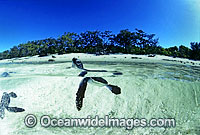
Green sea turtle hatchlings Chelonis mydas
emerging from sand (top left) making way
to the sea (bottom right). Loggerhead turtle hatchlings
Caretta caretta emerging from sand (top
right). |
|
Wesley Jones is a young scientist
whose zoology thesis involves the study of growth and energy
in hatchling Green sea-turtles. "At the moment it is
almost impossible to study hatchlings in the wild, so we
try to gather as much data about them as we can in captivity,"
says Jones. "When they first emerge, they are using
up the yolk sac as an energy reserve and they swim continuously
for about four or five days, just to escape the area where
there is a high concentration of predators."
For scientists such as Limpus, Gyuris and Jones, turtle
research must sometimes seem unrewarding. "The work
is longterm when you're looking at an animal that you think
lives 150 years. Scientists are probably not going to see
the fruits of their labour and the work they do will be
of more value in centuries to come," says Jones. Yet
it is only through their tireless research that we hopefully
may be able to learn enough about sea turtles to procure
a safe future for them.
As for the many remaining mysteries and unknowns about sea-turtles,
Wesley Jones sums it up by saying: "There are definitely
not going to be any shortage of questions that you can ask
about turtles for quite a while to come."
REFERENCES
1 . D. MACK, N. DUPLAIX and S. WELLS, Sea Turtles, Animals
of Divisible Parts: International Trade in Sea Turtle Products
- Biology and Conservation of Sea Turtles, Smithsonian Institution
Press (1981).
2. C.J. LIMPUS, The Status of Australian Sea Turtle Populations
- Biology and Conservation. of Sea Turtles, Srnithsonian
Institution Press (1981).
Text: Sandra Eugarde
Photography: Gary Bell
Published: Underwater Geographic - Australia
|